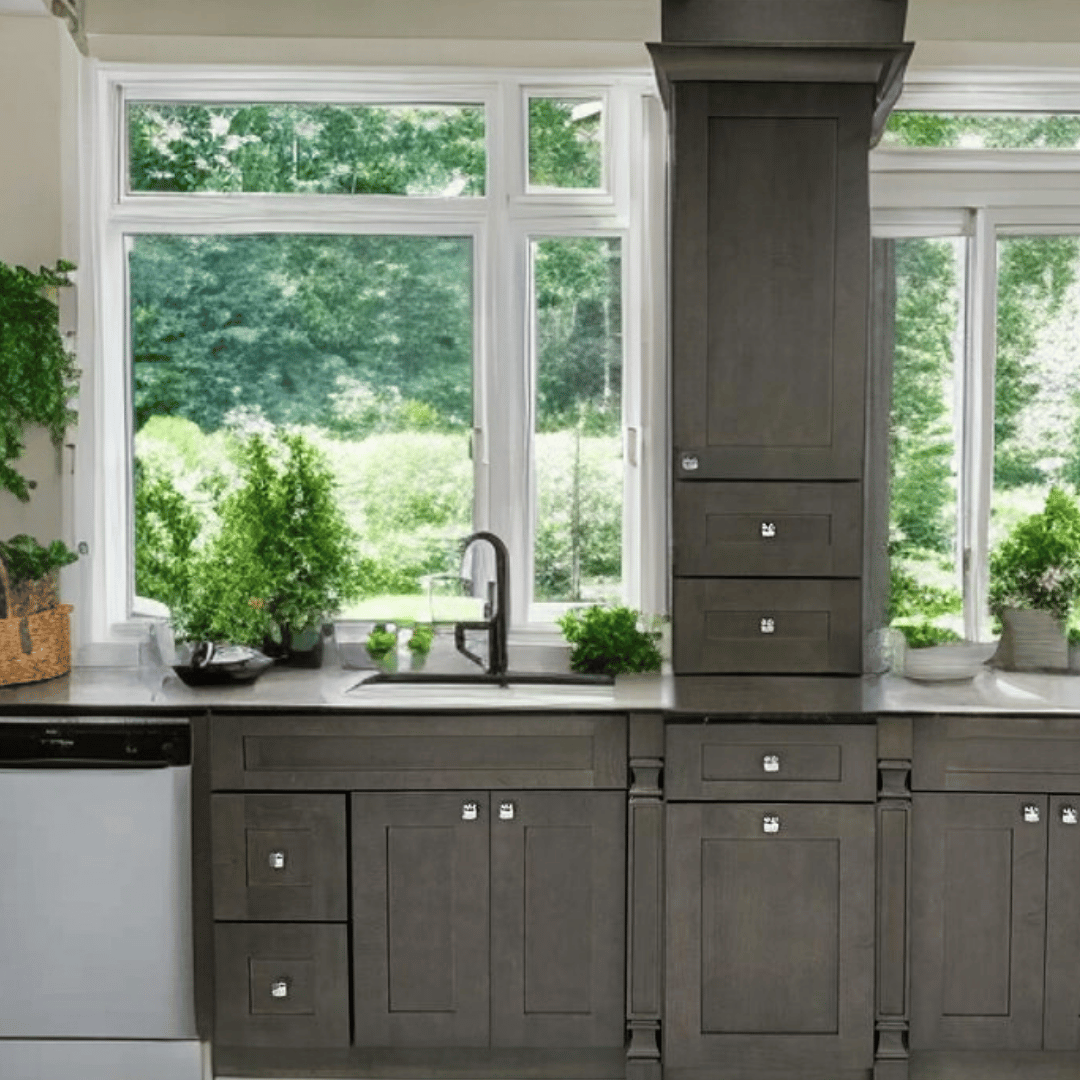
Exploring Kitchen Cabinet Symmetry and Asymmetry: Design Personalities Explained
Kitchen symmetry means mirroring cabinets around a center line, such as a range, hood, sink or window, so both sides match in width, height and hardware. Asymmetry means arranging unequal elements, such as a tall pantry against open shelves, so they still balance visually. Symmetry reads calm and traditional; asymmetry reads relaxed and modern. Most good kitchens use symmetry on the focal wall and controlled asymmetry elsewhere.
Key takeaways
- Pick one strong center line (range, sink or window) and mirror the cabinets around it.
- Fillers and cabinet widths solve most off-center problems; plan them on the drawing, not on site.
- Asymmetry works when visual weight balances: a tall cabinet on one side, open space or shelves on the other.
- Keep door style, finish and hardware consistent; let layout, not mixed materials, carry the asymmetry.
Understanding symmetry in kitchen design
Symmetry in kitchen design means balanced proportions, with elements evenly distributed on either side of a central axis. On a cabinet wall, the axis is usually the range and hood, the sink under a window, or a centered island. Matching cabinet widths, door pairs and hardware on both sides create a sense of order.
Many homeowners prefer a balanced look, and symmetry makes a kitchen feel organized and calm, especially in traditional homes.
How to build a symmetrical cabinet wall
- Find the center line: measure to the center of the range, sink or window.
- Choose matching cabinets on each side, using the same widths in mirror order.
- Put any filler at the ends of the run (against walls), never in the middle of the composition.
- Align wall cabinet doors with base cabinet doors below where possible.
- Match hardware placement and size on both sides.
- Finish with symmetrical lighting: pendants or sconces centered on the axis.
The appeal of asymmetry
Asymmetry uses unequal elements that still feel balanced. Instead of mirror images, it balances visual weight: a tall pantry tower on one end might be offset by a window, open shelving or a longer run of lower cabinets on the other.
Asymmetry suits modern and contemporary kitchens and rooms where architecture makes symmetry impossible, such as an off-center window, a door near a corner or a sloped ceiling.
How to make asymmetry look intentional
- Balance weight, not width: a tall cabinet carries more visual weight than a wide low one.
- Use the rule of thirds: place the focal element about a third of the way along the wall rather than slightly off center.
- Repeat something: one color, one hardware finish or one cabinet height that runs through the whole kitchen ties it together.
- Keep lines straight: tops of wall cabinets, crown and countertop heights should still align.
How symmetry and asymmetry affect kitchen personality
Symmetrical designs tend to feel calm and stable, suiting traditional and classic styles. Asymmetrical designs feel relaxed and energetic, suiting modern and eclectic tastes. Here is how they compare:
| Aspect | Symmetrical design | Asymmetrical design |
|---|---|---|
| Visual balance | Mirror image around a center line | Balanced by visual weight |
| Feel | Calm, orderly, formal | Relaxed, dynamic, modern |
| Style fit | Traditional, transitional, classic | Modern, eclectic, loft |
| Cabinet arrangement | Matching widths in mirror order | Varied heights and widths |
| Color use | Consistent palette | One accent color or zone |
| Hardest part | Off-center windows and walls | Avoiding a random, unplanned look |
Solving common layout problems
| Situation | Symmetrical fix | Asymmetrical approach |
|---|---|---|
| Window off-center over the sink | Center the sink on the window; adjust cabinet widths and fillers at the ends | Let a tall cabinet or shelves fill the larger side |
| Range wall with a corner on one side | Use a corner cabinet plus filler so the visible cabinets mirror | Run open shelves on the short side |
| Door or opening near one end | Shorten the composition to the clear wall and center on it | End the run with a tall pantry beside the opening |
| Uneven or out-of-square walls | Scribe fillers to the wall so reveals look even | Same: scribing applies either way |
| Island with seating on one side | Equal overhangs and centered pendants | Deeper overhang on one side or a seating end, balanced by storage |
Choosing the right style for your kitchen
If you want a classic look, symmetrical cabinetry with consistent finishes and hardware reinforces it. If you prefer a contemporary feel, asymmetrical arrangements let you express the room’s character. In most homes, the best answer is a symmetrical focal wall (range and hood, or sink and window) with more relaxed asymmetry on the other walls and the island.
At CCC Cabinets, the in-stock collections cover shaker styles and modern door styles in standard widths, which makes it straightforward to mirror cabinets around a center line. Explore the kitchen cabinet options for ideas.
Examples of symmetrical and asymmetrical kitchens
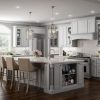
Symmetrical kitchen example
A traditional kitchen with white shaker cabinets mirrored on either side of a range and hood, matching glass-door wall cabinets, brass hardware in identical positions and a centered island with two pendants.
Asymmetrical kitchen example
A contemporary kitchen with a tall navy pantry wall on one end, a long run of white base cabinets with open shelves above on the other, and an island with seating on one side. One hardware finish and one countertop tie the composition together.
Tips for implementing symmetry and asymmetry in your kitchen
- Assess your space: measure every wall and mark windows, doors, vents and outlets before choosing an approach.
- Choose a focal point: an island or range hood anchors either style.
- Mix with intent: symmetry on the focal wall, asymmetry elsewhere.
- Coordinate color: in asymmetrical designs, limit accent color to one zone, such as the island or pantry wall.
- Use hardware consistently: the same finish everywhere; sizes scaled to each drawer. See our hardware size guide.
- Plan fillers on paper: decide where every filler goes before ordering, so the visible composition stays balanced.
The role of color and materials
For symmetrical kitchens, a cohesive palette strengthens the sense of order. Asymmetrical kitchens can use one bold color or a wood tone to define a zone, but too many materials make the room feel random.
CCC Cabinets builds every style with plywood boxes and birch face frames from CCC Cabinets, so mixed colors still share the same construction and door sizes. Stained styles such as espresso shaker cabinets and millennium grey cabinets work well as an island or pantry accent, while painted styles such as Pure White and Shaker Blue suit mirrored perimeter runs.
Conclusion
Symmetry and asymmetry each give a kitchen a different personality. Choose a clear center line for symmetry, balance visual weight for asymmetry, and plan fillers and hardware on the drawing so either approach looks intentional. For more on choosing cabinets, see our guide on selecting kitchen cabinets, or visit the CCC Cabinets showroom at 2180 S Wolf Rd, Des Plaines, and call (872) 241-5525.
FAQ
What is the difference between symmetrical and asymmetrical kitchen designs?
Symmetrical kitchens mirror cabinets, appliances and hardware around a center line such as a range, sink or window. Asymmetrical kitchens arrange unequal elements, such as a tall pantry against open shelving, so they balance by visual weight rather than by matching each other.
Should kitchen cabinets be symmetrical?
Not everywhere. A symmetrical focal wall, usually the range and hood or the sink and window, looks orderly and suits most homes. Other walls and the island can be asymmetrical when the room’s windows, doors or corners make mirroring impractical.
How do I make cabinets symmetrical when the window is off-center?
Center the sink and the wall cabinets on the window, then use cabinet widths and fillers at the ends of the run to absorb the difference. If the gap is large, put a tall cabinet or open shelves on the wider side so the wall still balances.
Can an asymmetrical kitchen island work?
Yes. An island with seating on one side or one end, or a deeper overhang on one side, is common. Balance it with storage on the working side, center the pendants on the island’s length and keep the countertop edges straight and aligned with the room.
Can I mix symmetry and asymmetry in my kitchen?
Yes, and most well-designed kitchens do. Use symmetry on the focal wall and relaxed asymmetry elsewhere, tied together with one door style, a consistent hardware finish and aligned cabinet heights.
What should I do if my kitchen cabinets look uneven?
Check whether the problem is layout or installation. Uneven door gaps usually need hinge adjustment; cabinets that are not level need shimming. If the layout itself looks off-balance, adjust filler placement, center hardware and lighting on a focal point, or add a tall element to rebalance the wall.
Which works better in a small kitchen, symmetry or asymmetry?
Small kitchens often benefit from symmetry because it makes the space feel orderly and calm. Where a window or door prevents it, keep the asymmetry simple: one tall element, consistent cabinet heights and a single color.
More in Cabinet Guides
Sourcing cabinets for a Chicagoland project?
CCC Cabinets supplies 15 door styles — including Mini White Shaker cabinets — at wholesale prices from our Des Plaines, IL warehouse. Confirm availability for your door style, then choose warehouse pickup near O’Hare or scheduled delivery across Chicagoland.
Door styles to explore: Mini White Shaker · Pure White · Shaker Blue
Browse all cabinet styles · Open a dealer account · Call (872) 241-5525 · Talk to our team