
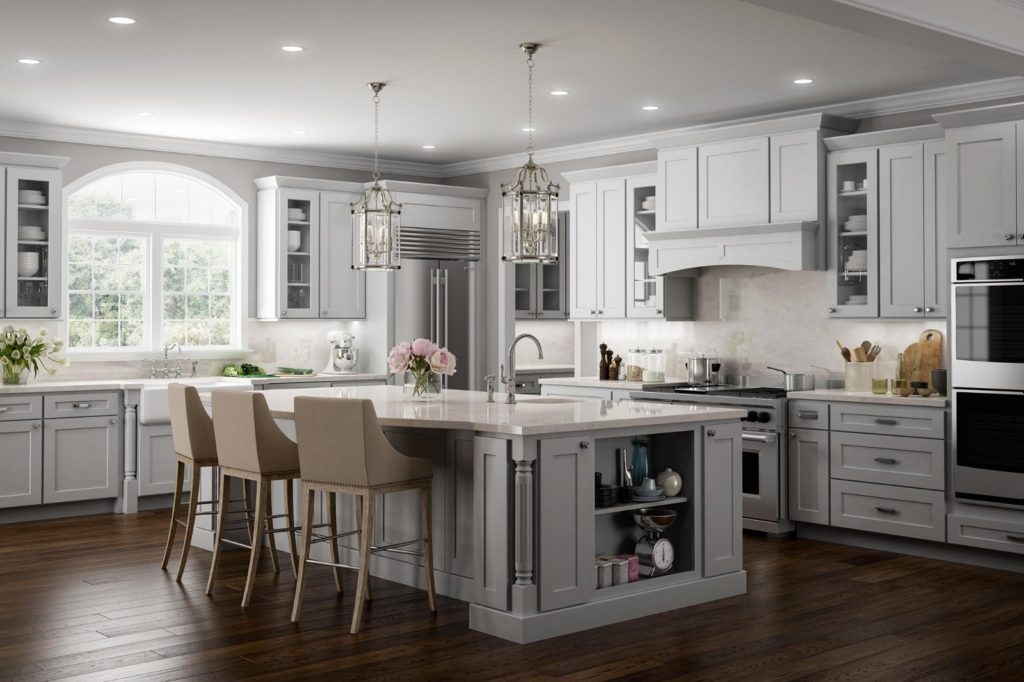
The Complete Guide to Choosing Cabinet Hardware Size in Proportion to Door and Drawer Scale
To choose cabinet hardware size, use the one-third rule: a drawer pull should be roughly one-third the width of the drawer front, rounded to a standard center-to-center size, and doors usually take a knob of about 1-1/4 inches or a pull mounted on the door frame. Wide drawers over about 30 inches can take one long pull or two shorter ones. Measure pulls by hole spacing, not overall length.
Key takeaways
- Pull size is the center-to-center (CC) distance between the screw holes; the overall length is longer.
- One-third of the drawer width is a starting point; round to the nearest common CC size.
- Door profile matters: the pull or knob sits on the frame (stile), so narrow mini shaker frames suit slimmer hardware.
- Order one sample of each size and test it on a real door and drawer before ordering the whole kitchen.
Understanding cabinet hardware basics
Cabinet hardware refers to the knobs, pulls and handles you grip, plus the hinges and glides inside. Visible hardware is both functional and decorative: it sets how easily drawers open and how balanced the fronts look.
- Knobs: a single screw; sized by diameter (or width for square knobs).
- Bar and cup pulls: two screws; sized by center-to-center hole spacing.
- Appliance pulls: long, heavy-duty pulls for tall pantry doors or panel-ready appliances.
- Edge and tab pulls: mount on the top edge of the front for a minimal look.
Why size matters in cabinet hardware
Oversized hardware overwhelms small doors, while undersized hardware gets lost on wide drawers and is harder to grip when a drawer is full of pots. The right size makes drawers easy to open with one hand and keeps the cabinet fronts visually balanced.
Key considerations for size
- Proportion: size hardware relative to the front it sits on.
- Function: heavy drawers need a pull you can wrap your fingers around.
- Visual weight: a chunky pull looks larger than a slim one with the same CC size.
- Consistency: use as few sizes as possible so the kitchen reads as one design.
Measuring cabinet doors and drawers
Step-by-step measurement guide
- Gather your tools: a tape measure, pencil and a list of every door and drawer.
- Measure drawer front width for every drawer size in the kitchen.
- Measure drawer front height; very short drawer fronts limit cup pulls.
- Measure door width and height, and the width of the door frame (stile) where the hardware sits.
- Group the results into a few size families, so you can buy a small number of hardware sizes.
Once you have these measurements, apply the one-third rule to the drawers and pick door hardware that suits the frame width.
Choosing the right size for knobs and pulls
Pulls for drawers
Divide the drawer width by three, then round to the nearest common center-to-center size. Many pulls are sold in metric hole spacings based on 32 mm increments; inch equivalents are shown below.
| Drawer front width | One-third rule | Common CC pull size to consider |
|---|---|---|
| 12 inches | 4 inches | 96 mm (about 3-3/4 in) or a knob |
| 15 inches | 5 inches | 128 mm (about 5 in) |
| 18 inches | 6 inches | 160 mm (about 6-5/16 in) |
| 24 inches | 8 inches | 192 mm (about 7-9/16 in) or 224 mm (about 8-13/16 in) |
| 30 inches | 10 inches | 256 mm (about 10-1/16 in) |
| 36 inches | 12 inches | 320 mm (about 12-5/8 in) or two smaller pulls |
For a 30-inch drawer, for example, a pull of about 10 inches CC is in proportion. On wide, heavy drawers, two pulls make opening easier and keep the drawer from racking.
Knobs and pulls for doors
Door knobs are commonly about 1-1/4 inches in diameter; small doors can take about 1 inch and large doors up to about 1-1/2 inches. If you prefer pulls on doors, a 96 mm to 128 mm pull suits most standard base and wall doors, mounted vertically on the stile opposite the hinges. Tall pantry doors often take a longer pull or an appliance pull.
Matching hardware to the door profile
| Door profile | Hardware that fits | CCC examples |
|---|---|---|
| Standard shaker | Bar pulls or cup pulls; knobs on doors | Pure White, Shaker Blue |
| Mini shaker (narrow frame) | Slim pulls and smaller knobs that fit the narrow stile | Mini White Shaker, Mini Shaker Cappuccino |
| Raised panel | Classic knobs, cup pulls, traditional bar pulls | Millennium White, Millennium Grey |
Material and style considerations
Material and finish change how big hardware looks. Heavy, chunky brass or iron looks larger than a slim stainless bar of the same CC size; minimalist designs can go a size smaller without looking lost.
Popular hardware materials
- Brass: classic warmth, available in polished, brushed and aged finishes.
- Stainless steel: modern and durable, a common match for stainless appliances.
- Zinc alloy: widely used for plated finishes such as matte black and nickel.
- Plastic: budget-friendly but rarely conveys quality on a full kitchen.
Choosing hardware styles
Traditional kitchens suit cup pulls and classic knobs; transitional kitchens suit simple bar pulls; modern kitchens suit long slim pulls or edge pulls. Keep the style consistent with the door profile and the rest of the house.
Common mistakes to avoid
1. Ordering by overall length
Listings often show overall length and CC spacing; drilling uses the CC size. Confirm CC before buying replacements or adding to an existing kitchen.
2. Overlooking proportions
Using one small pull size on every drawer, including wide ones, makes large drawers look underdressed and harder to open.
3. Ignoring function
Edge and tab pulls look clean but can be harder to grip on heavy drawers; test before committing.
4. Forgetting about finish
Shiny finishes reflect light and read larger; matte finishes read smaller. Plan sizes with the finish in mind.
5. Drilling before checking clearance
Check that pulls clear adjacent appliances, wall corners and other drawers when opened; placement details are covered in our hardware spacing and placement standards guide.
Expert tips for selecting hardware
- Sample first: buy one of each size and hold it against a real door and drawer before ordering the whole kitchen.
- Limit sizes: two or three pull sizes plus one knob size cover most kitchens.
- Mix types with a plan: knobs on doors and pulls on drawers is a classic combination; our guide to knobs vs pulls covers when each works best.
- Use a drilling template: a jig keeps holes consistent across dozens of fronts.
- Count carefully: list every door and drawer by size before ordering, plus a few spares.
Cabinets that make hardware planning easy
CCC Cabinets stocks 15 full overlay door styles with consistent sizes, so a hardware plan made for one kitchen works for repeat projects. Doors hang on 6-way adjustable soft-close hinges, and drawers run on full-extension soft-close glides, which keeps fronts aligned so hardware lines up across a run. Browse the in-stock styles on the CCC Cabinets cabinets page.
Frequently Asked Questions
What size cabinet hardware should I choose?
Start with the one-third rule: choose a drawer pull about one-third the width of the drawer front, rounded to a standard center-to-center size. Doors usually take a knob of about 1-1/4 inches or a pull of about 96 mm to 128 mm. Very wide drawers can take one long pull or two shorter ones.
How do I measure cabinet pulls?
Measure the center-to-center distance between the two screw holes. That number, often listed in millimeters such as 96, 128 or 160 mm, is the pull size. The overall length is longer and is listed separately, so check both when replacing hardware.
What size pull goes on a 30-inch drawer?
One-third of 30 inches is 10 inches, so a pull of about 10 inches center to center, such as a 256 mm pull, is in proportion. Two smaller pulls also work and make a heavy, wide drawer easier to open evenly.
Should all cabinet hardware be the same size?
No. Using one small size everywhere makes wide drawers look underdressed. Most kitchens look best with two or three pull sizes matched to drawer widths, plus one knob size for doors, all in the same style and finish.
What size knobs are standard for kitchen cabinet doors?
About 1-1/4 inches in diameter is the most common knob size for kitchen doors. Small doors can take about 1 inch, and larger doors or heavier styles can go up to about 1-1/2 inches.
Can I use pulls instead of knobs on cabinet doors?
Yes. Pulls on doors give a more modern, uniform look and are easier to grab. Mount them vertically on the frame opposite the hinges, usually in a 96 mm to 128 mm size for standard doors and longer for tall pantry doors.
Conclusion
Choosing cabinet hardware size comes down to measuring every front, applying the one-third rule, rounding to standard center-to-center sizes and testing samples on real doors. To plan a kitchen with consistent, stocked door styles, visit the CCC Cabinets showroom at 2180 S Wolf Rd, Des Plaines, call (872) 241-5525, or contact us.
More in Cabinet Hardware
Sourcing cabinets for a Chicagoland project?
CCC Cabinets supplies 15 door styles — including Mini White Shaker cabinets — at wholesale prices from our Des Plaines, IL warehouse. Confirm availability for your door style, then choose warehouse pickup near O’Hare or scheduled delivery across Chicagoland.
Door styles to explore: Mini White Shaker · Pure White · Millennium White
Browse all cabinet styles · Open a dealer account · Call (872) 241-5525 · Talk to our team