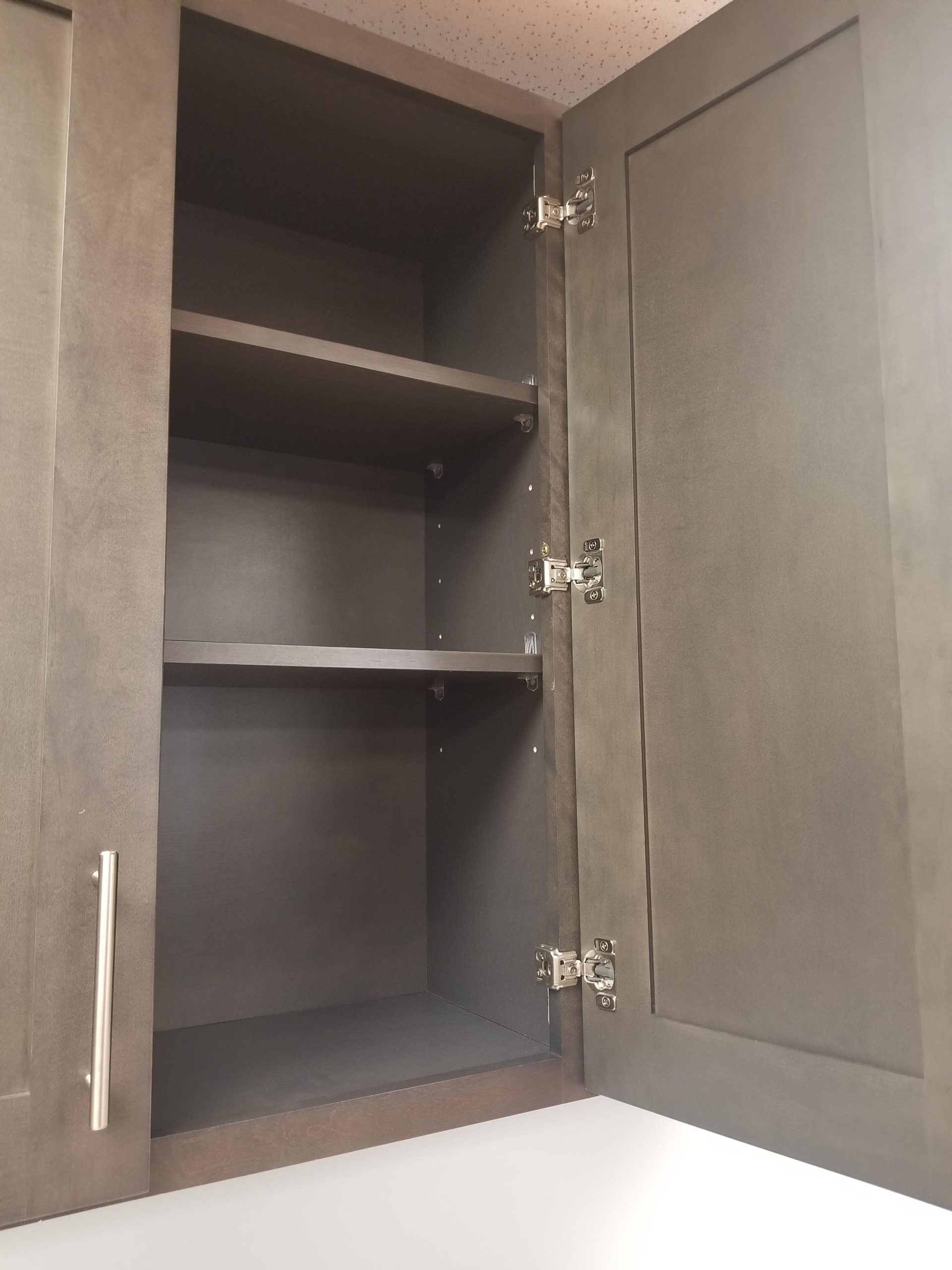
How Solid Wood Cabinet Doors Outperform Particle Board in Durability and Appearance
Yes, there is a real durability difference. Doors with solid hardwood frames hold hinge screws, resist dents at the edges and can be repaired, while particleboard doors and boxes can chip at the edges and swell if water gets into exposed edges. For RTA cabinets the box matters as much as the door: plywood boxes with solid-wood dovetail drawers outlast particleboard boxes with cam locks and stapled drawers.
Key takeaways
- Compare the door frame, the door panel, the box and the drawers separately; “solid wood cabinets” often describes only part of the cabinet.
- Solid hardwood is best for door frames, face frames and drawer boxes; plywood is best for boxes and shelves.
- MDF is a good choice for painted door center panels because it stays flat and smooth.
- Particleboard is the budget choice; protect it from water, especially at the sink base.
Solid wood, plywood, MDF and particleboard compared
| Material | Strengths | Weaknesses |
|---|---|---|
| Solid hardwood | Strong at edges and joints; holds screws; can be sanded and refinished | Moves with humidity; wide flat panels can crack paint at joints |
| Plywood | Stable, strong for its weight, holds fasteners, tolerates occasional moisture well | Edges need edge banding or a face frame to look finished |
| MDF | Very smooth and stable; excellent for painted panels | Heavy; swells if edges soak in water |
| Particleboard | Lowest cost; flat surface for laminates | Weak screw holding; edges chip and swell when wet |
Durability: Solid Wood vs. Particle Board
Hinge and fastener holding
Concealed hinges are screwed into the back of the door. Hardwood frames hold those screws tightly over years of opening and closing. Particleboard can lose its grip around screws, so hinges loosen and doors sag.
Edges and impact
Door edges take bumps from pots, chairs and vacuum cleaners. Hardwood dents but rarely crumbles; particleboard edges can chip, and once the surface laminate breaks, the core is exposed.
Moisture
Kitchens see spills, steam and leaks. Water that reaches an exposed particleboard edge can make it swell permanently. Plywood and hardwood tolerate occasional moisture better, though any cabinet should be kept dry.
Repairability
Hardwood can be filled, sanded and refinished. Damaged particleboard usually has to be replaced.
RTA cabinets: is there a durability difference?
For ready-to-assemble cabinets, the difference is significant, and it is mostly in the box:
- Box panels: plywood RTA boxes hold their connectors firmly; particleboard boxes rely on cam locks that can loosen if the cabinet is moved or reassembled.
- Drawers: solid-wood dovetail drawers stay tight; stapled particleboard drawers loosen at the corners.
- Back panel: a full plywood back keeps the box square and gives a solid surface for mounting screws.
- Assembly: follow the instructions, install every connector and check each box for square.
For more on the format itself, see RTA vs. assembled cabinets.
The Aesthetic Appeal of Solid Wood Cabinet Doors
- Natural grain: stained hardwood shows real grain that printed surfaces imitate.
- Crisp profiles: hardwood frames hold sharp edges on Shaker and raised-panel doors.
- Paint quality: a hardwood frame with an MDF center panel gives painted doors a smooth, stable surface.
- Aging: laminate and thermofoil surfaces can peel near heat; wood finishes can be touched up.
Health and formaldehyde: what to ask
Composite wood products such as hardwood plywood, MDF and particleboard are covered by the EPA’s TSCA Title VI formaldehyde emission standards, which require these products, including finished goods that contain them, to be labeled TSCA Title VI compliant. Ask your supplier which labeling or documentation applies to the cabinets you are buying.
Cost-Effectiveness: Long-Term Value
- Fewer callbacks: hardwood frames and plywood boxes hold up better in sink bases and heavy drawers.
- Repairs instead of replacement: wood parts can often be refinished.
- Spend where it fails: if budget is tight, prioritize plywood at the sink base and solid-wood drawers in high-use drawer bases.
How CCC Cabinets builds its doors and boxes
CCC Cabinets uses each material where it performs best, on all 15 door styles:
- Door frame: 3/4″ solid birch on most styles (HDF on some styles; check the style page)
- Door center panel: MDF, for a smooth, stable finish
- Face frame: 3/4″ birch
- Box sides: 1/2″ A-grade plywood with wood veneer; back: 1/2″ full plywood
- Shelves: 3/4″ A-grade plywood
- Drawers: 17 mm solid-wood dovetail boxes with 3/8″ plywood bottoms
Every style is available assembled or ready-to-assemble with the same construction. See examples such as Pure White and Espresso Shaker, or browse all wholesale kitchen cabinets.
Choosing the Right Cabinets for Your Project
- Ask for a spec sheet listing door frame, door panel, box, back, shelf and drawer materials.
- Inspect a cabinet in a showroom: box edges, drawer corners, hinge mounting.
- Check the warranty, including finish coverage and exclusions.
- Compare quotes using the same box list; see how to compare cabinet quotes.
Frequently Asked Questions
Is there a significant durability difference between particle board and solid wood RTA cabinets?
Yes. In RTA cabinets, solid wood and plywood parts hold connectors and hinge screws far better than particleboard, resist chipped edges and tolerate occasional moisture without swelling. The biggest differences show in the box and drawers, so check box material, back panel and drawer construction, not just the doors.
Are solid wood cabinet doors better than MDF doors?
It depends on the finish. For stained doors, solid hardwood shows natural grain. For painted doors, a solid hardwood frame with an MDF center panel is often the best combination, because MDF stays flat and smooth while the frame provides strength at the edges and hinge locations.
How long do particleboard cabinets last?
It varies with quality, use and moisture. Particleboard cabinets can serve for years in dry, low-use areas, but sink bases, dishwasher-adjacent cabinets and heavily used drawers tend to fail first when water reaches exposed edges or fasteners loosen. Plywood and hardwood parts generally last longer in those locations.
Can solid wood cabinets be refinished?
Yes. Solid wood can be cleaned, sanded and refinished or painted, which is one of its main long-term advantages. Particleboard with a laminate or thermofoil surface usually cannot be refinished once the surface is damaged and must be replaced.
Are CCC cabinet doors solid wood?
On most CCC styles, the door frame is 3/4-inch solid birch, and some styles use HDF for the frame. The door center panel is MDF on every style, chosen for a smooth, stable finish. Cabinet boxes are 1/2-inch A-grade plywood, and drawer boxes are 17 mm solid wood with dovetail joints.
Conclusion
Solid wood door frames and plywood boxes outlast particleboard in the places cabinets fail first: hinges, edges, sink bases and drawers. Compare the whole construction, not just the label. To see CCC construction in person, visit the showroom at 2180 S Wolf Rd, Des Plaines, contact us, or call (872) 241-5525.
More in Materials & Construction
Sourcing cabinets for a Chicagoland project?
CCC Cabinets supplies 15 door styles — including Pure White cabinets — at wholesale prices from our Des Plaines, IL warehouse. Confirm availability for your door style, then choose warehouse pickup near O’Hare or scheduled delivery across Chicagoland.
Door styles to explore: Pure White · Espresso Shaker · Black Roast
Browse all cabinet styles · Open a dealer account · Call (872) 241-5525 · Talk to our team