The Complete Guide to Framed vs. Frameless Cabinet Construction Differences
The difference between framed and frameless cabinets is the front of the box. Framed cabinets have a solid wood face frame glued to the front, and the doors hang on that frame. Frameless (European-style) cabinets have no face frame; doors mount to the box sides, giving slightly wider openings and a flatter look. Framed suits traditional and transitional kitchens and forgiving installs; frameless suits modern designs and maximum access.
Key takeaways
- Framed cabinets add a hardwood frame that stiffens the box and gives fasteners and hinges solid wood to grip.
- Frameless cabinets offer full access and slightly more usable interior width, with tight, even door gaps.
- Both can be durable; box material, joinery and hardware matter more than the frame alone.
- Framed cabinets accept full overlay, partial overlay or inset doors; frameless is almost always full overlay.
- Frameless installs demand flatter walls and more precise alignment.
1. Understanding Framed Cabinet Construction
Framed cabinets, common in American kitchens, have a face frame of solid wood stiles and rails on the front of the box. Doors and drawer fronts mount to the frame. The frame adds rigidity, keeps the box square during shipping and installation, and helps cabinets line up when they are clamped and screwed together in a run.
Key Features of Framed Cabinets
- Face frame: a solid hardwood frame on the front of the box.
- Door options: full overlay, partial overlay or inset.
- Forgiving installation: the frame can be scribed and adjusted to uneven walls.
2. Understanding Frameless Cabinet Construction
Frameless cabinets, often called European or full-access cabinets, have no front frame. The box edges are banded, and doors mount with concealed hinges directly to the box sides. Full overlay doors cover nearly the entire front, so the kitchen reads as a continuous surface.
Key Features of Frameless Cabinets
- Full access: no frame narrows the opening, so drawers and pull-outs can be slightly wider.
- Clean look: tight, even gaps suit modern slab doors.
- Precise system: parts are typically drilled on a standard grid for hinges and shelves.
3. Key Differences Between Framed and Frameless Cabinets
| Feature | Framed | Frameless |
|---|---|---|
| Front of box | Solid wood face frame | Banded box edges, no frame |
| Interior access | Frame narrows the opening slightly | Full access to the box width |
| Door options | Full overlay, partial overlay, inset | Almost always full overlay |
| Typical look | Traditional to transitional; shaker and raised panel | Modern; slab and minimal doors |
| Hinges | Face-frame mounting plates | Side-mounted plates |
| Installation | More forgiving on uneven walls | Needs flatter walls and precise alignment |
4. Advantages of Framed Cabinets
- Rigidity: the face frame stiffens the box and resists racking.
- Strong attachment points: hinges and fasteners go into solid hardwood.
- Design range: works with shaker, raised panel, inset and traditional details.
- Easier to install in older homes: fillers and scribing handle out-of-square walls.
5. Advantages of Frameless Cabinets
- More usable space: full-width openings for drawers and pull-outs.
- Modern aesthetic: continuous fronts and narrow reveals.
- Easy interior cleaning: no frame edge to catch crumbs at the opening.
6. Cost Comparison of Framed vs. Frameless Cabinets
Cost depends more on the specific line, box material, finish and hardware than on framed or frameless construction alone. Compare quotes on the same specification: box material and thickness, back panel, drawer construction, hinges and finish. Request quotes from more than one supplier for the same cabinet list.
7. Tips for Choosing Between Framed and Frameless Cabinets
- Match the house: framed for traditional and transitional homes; frameless for modern designs.
- Check the walls: older homes with uneven walls favor framed cabinets.
- Think about storage: if every inch of drawer width matters, frameless helps.
- Look at the door style: inset and partial overlay require framed construction.
- Compare full specs: a well-built framed cabinet beats a poorly built frameless one and vice versa.
For a contractor-focused view, see frameless vs face-frame cabinets: the contractor’s breakdown.
CCC Cabinets Construction
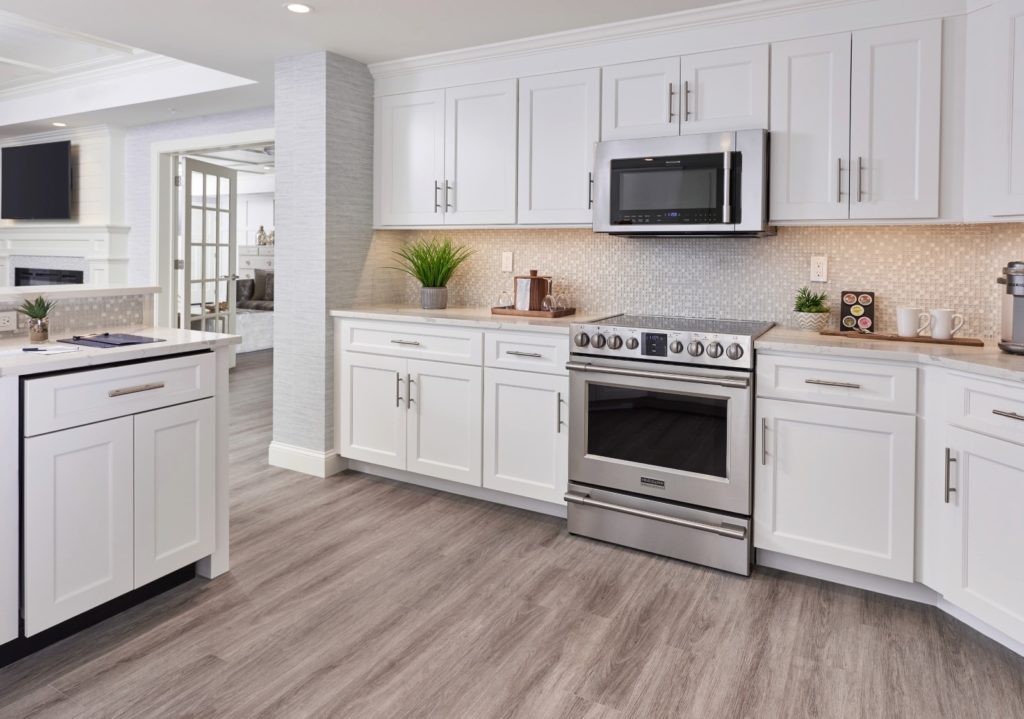
CCC Cabinets builds all 15 in-stock styles as framed cabinets with full overlay doors: 3/4″ birch face frames, 1/2″ A-grade plywood box sides with wood veneer, a 1/2″ plywood back, 3/4″ plywood adjustable shelves, 17 mm solid wood dovetail drawers on full-extension soft-close glides and 1-1/4″ concealed 6-way adjustable soft-close hinges. Full overlay doors give a clean look close to frameless while keeping the strength of a face frame. Browse Pure White, Shaker Blue and the rest of the cabinet collections; see full overlay vs half overlay doors for the door side.
8. Frequently Asked Questions
What is the difference between framed and frameless cabinets?
Framed cabinets have a solid wood face frame on the front of the box, and the doors attach to it. Frameless cabinets have no face frame; doors attach to the box sides. Frameless gives full access and a modern look, while framed adds rigidity and supports more door styles.
Are framed cabinets more durable than frameless?
Not automatically. The face frame adds rigidity and solid wood for hinges, but durability depends mostly on box material, joinery, drawers and hardware. A plywood frameless cabinet can outlast a particleboard framed cabinet. Compare full specifications.
Which is more expensive, framed or frameless?
It depends on the line. Price is driven more by materials, finish, hardware and whether the cabinets are stock, semi-custom or custom than by the presence of a face frame. Compare quotes on the same specification.
Can full overlay framed cabinets look like frameless?
Largely, yes. Full overlay doors cover most of the face frame, leaving narrow gaps, so the kitchen looks continuous. The difference shows mainly when doors are open, where the frame edge slightly narrows the opening.
Are frameless cabinets harder to install?
They require flatter walls and more precise alignment, because there is no frame to scribe or adjust and the reveals are tight. Framed cabinets are more forgiving in older homes with uneven walls and floors.
See Framed Full-Overlay Cabinets in Person
Visit the CCC Cabinets showroom at 2180 S Wolf Rd in Des Plaines or call (872) 241-5525. Contractors can open a trade account.
More in Cabinet Guides
Sourcing cabinets for a Chicagoland project?
CCC Cabinets supplies 15 door styles — including Mini White Shaker cabinets — at wholesale prices from our Des Plaines, IL warehouse. Confirm availability for your door style, then choose warehouse pickup near O’Hare or scheduled delivery across Chicagoland.
Door styles to explore: Mini White Shaker · Pure White · Shaker Blue
Browse all cabinet styles · Open a dealer account · Call (872) 241-5525 · Talk to our team