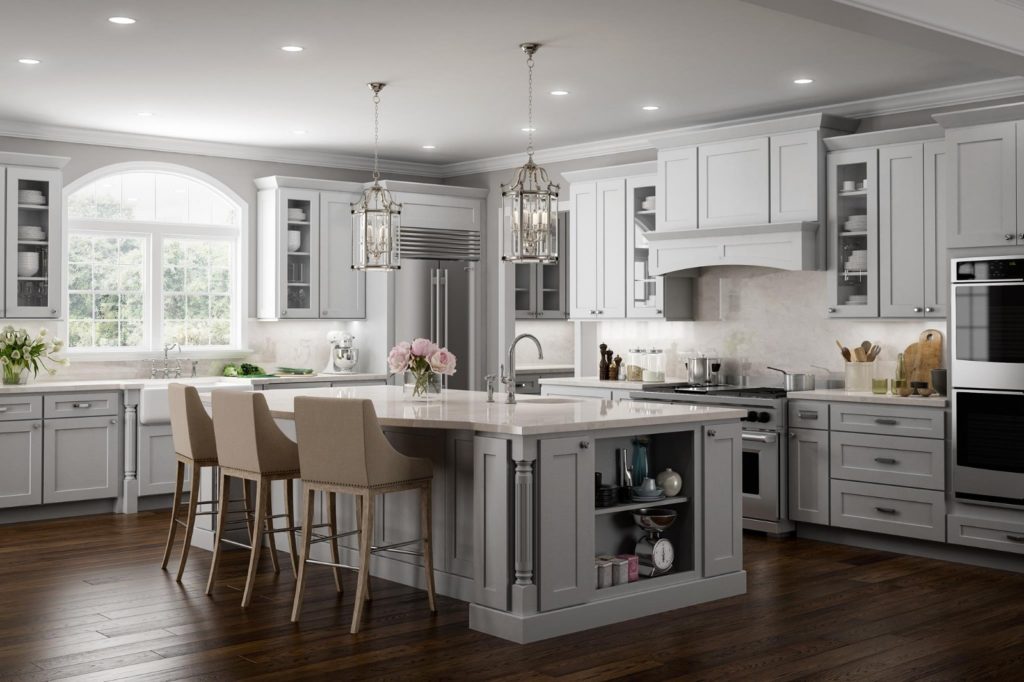
Why Solid Wood vs. MDF Cabinet Door Core Material Affects Performance and Appearance
A cabinet door’s core decides how it looks and how it behaves over time. Solid wood moves with humidity and shows natural grain, which suits stained doors. MDF is smooth and stable, which suits painted doors but needs well-sealed edges because it swells if water gets in. That is why many quality painted doors combine a wood or HDF frame with an MDF center panel, while stained doors use wood or wood veneer.
Key takeaways
- A five-piece door has a frame (stiles and rails) and a center panel; each part can be a different material.
- For painted doors, an MDF center panel avoids the hairline paint cracks that appear when a panel of solid lumber expands and contracts.
- For stained doors, wood or wood veneer shows real grain.
- Moisture is the main enemy of MDF: every edge must be sealed, and water should not stand on it.
1. Understanding solid wood and MDF
Solid wood is sawn lumber from species such as maple, oak, cherry or birch. It is strong, holds screws well and shows natural grain, but it expands and contracts across the grain as humidity changes. MDF (medium density fiberboard) is made from fine wood fibers bonded with resin and pressed into dense, uniform sheets. It is very flat and stable and takes paint smoothly, but it is heavy and vulnerable to swelling at unsealed edges. HDF (high density fiberboard) is a denser relative used for some door frames.
Common cabinet door terms
- Stiles and rails: the vertical and horizontal pieces that form a five-piece door’s frame.
- Center panel: the flat or raised panel inside the frame.
- Slab door: a single flat piece with no frame.
- Overlay: how much the door covers the cabinet’s face frame; full overlay covers most of it.
- Face frame: the solid wood frame on the front of a framed cabinet box, separate from the door.
Four common door constructions
| Construction | Strengths | Best suited to |
|---|---|---|
| Solid wood frame and wood panel | All-wood look and feel; real grain throughout | Stained doors |
| Solid wood frame and MDF panel | Wood frame strength with a stable, smooth panel | Painted shaker and raised-panel doors |
| HDF frame and MDF panel | Dense, stable, very smooth surface for paint | Painted shaker doors |
| One-piece MDF (slab or routed) | No joints to crack; smooth paint surface | Painted slab or routed-profile doors |
2. Performance comparison
Durability and screw holding
Solid wood resists dents well (depending on species) and holds screws strongly. MDF holds screws adequately on its face but less well at the edges and after repeated reinstallation. Hinges mount into bored cups, which works well in both when installed correctly.
Stability and movement
Wood moves across its grain with seasonal humidity changes. In a five-piece door the panel floats in a groove so the movement does not split the door, but on painted doors the movement can open a visible line in the paint where panel meets frame. MDF barely moves, so painted MDF panels stay crack-free.
Moisture resistance
Both materials need a good finish. Unfinished solid wood absorbs moisture and can warp; MDF can swell permanently if water reaches an unsealed edge. Keep doors near sinks and dishwashers dry and wipe up drips promptly.
Weight
MDF is denser than most cabinet woods, so large MDF doors are heavier. Tall and wide doors need hinges rated for the weight; see our guide to door weight and hinge capacity.
3. Aesthetic considerations
Stained wood shows grain and natural color variation, which many buyers value in warm, traditional or transitional kitchens. Painted MDF gives a crisp, uniform surface and clean edges, ideal for white, grey, navy and other solid colors.
| Feature | Solid wood | MDF |
|---|---|---|
| Grain and variation | Natural, unique to each door | None; uniform |
| Best finish | Stain or clear finish | Paint, or veneer over MDF |
| Paint quality over time | Joints can show hairline cracks | Stays smooth and continuous |
| Shaping | Profiles follow the grain | Routes cleanly into any profile |
4. Cost analysis
Cost depends more on species, finish and construction than on wood versus MDF alone. All-wood doors in premium species cost more; painted doors with MDF panels often cost less while performing better for paint. Compare doors by construction and finish quality, not by the material name.
5. Environmental and health considerations
MDF, particleboard and hardwood plywood sold in the US must meet federal formaldehyde emission standards. According to the EPA, composite wood products, including finished goods containing them, must be labeled TSCA Title VI compliant. Ask for documentation if you are comparing lines.
6. Recommendations for choosing the right material
- Painted kitchen: wood or HDF frame with an MDF center panel, or a one-piece MDF door.
- Stained kitchen: wood frame with a wood or veneered panel.
- High-moisture areas: any door with all edges sealed; keep water off.
- Large doors: check hinge capacity and consider more hinges on tall doors.
- Box first: the cabinet box matters as much as the door; see our cabinet materials guide.
How CCC Cabinets builds its doors
Every CCC door uses an MDF center panel (some styles with applied veneer), on 3/4-inch birch face frames with full overlay. The door frame differs by style, as listed on each style page:
| Door frame | CCC styles | Finish type |
|---|---|---|
| 3/4-inch solid birch | Pure White, Millennium White, Millennium Off White | Painted |
| 3/4-inch solid birch | Espresso Shaker, Dark Grey, Millennium Grey, Cappuccino Shaker | Stained |
| HDF | Light Grey, Shaker Blue, Millennium Blue, Mini White Shaker, Black Roast, Matcha Latte | Painted |
| HDF | Millennium Cappuccino, Mini Shaker Cappuccino | Stained |
Behind every door is the same box: 1/2-inch A-grade plywood sides, 3/4-inch plywood shelves, 17 mm solid wood dovetail drawers and 6-way adjustable soft-close hinges. See all styles at CCC Cabinets.
7. Frequently Asked Questions
Is MDF good for cabinet doors?
Yes, especially for painted doors. MDF is smooth and stable, so paint stays even and does not crack at panel joints. It needs every edge sealed and should be kept dry, because MDF swells if water reaches raw edges. For stained doors with visible grain, wood or veneer is the better choice.
Are solid wood cabinet doors better than MDF?
Not always. Solid wood is best for stained doors that show grain. For painted doors, wood panels move with humidity and can open hairline cracks at the joints, which is why many quality painted doors use an MDF center panel in a wood or HDF frame.
What is the best wood for kitchen cabinets?
Maple, birch, oak and cherry are common choices. Maple and birch have fine, even grain that suits paint and light stains; oak has a pronounced grain; cherry darkens with age. For the cabinet box, plywood is generally preferred over particleboard.
What is HDF and how is it different from MDF?
HDF is high density fiberboard, denser and harder than MDF. It machines cleanly and stays dimensionally stable, which makes it suitable for painted door frames. Like MDF, it needs a good finish on all edges to keep moisture out.
What are the parts of a cabinet door called?
A five-piece door has two vertical stiles, two horizontal rails and a center panel. The panel can be flat, as on shaker doors, or raised with a beveled edge. A slab door is a single flat piece with no separate frame or panel.
Do MDF cabinet doors hold up in kitchens?
Yes, when they are well finished and kept dry. Quality painted MDF doors resist warping and keep a smooth finish for years. Damage usually comes from water left on edges near the sink or dishwasher, or from impacts that chip the paint.
8. Conclusion
The right door core depends on the finish: wood or veneer for stained doors, MDF panels in a wood or HDF frame for painted doors, and sealed edges for both. To see how each CCC style is built, visit the showroom at 2180 S Wolf Rd, Des Plaines, call (872) 241-5525, or browse CCC Cabinets online.
More in Cabinetry Insights
Sourcing cabinets for a Chicagoland project?
CCC Cabinets supplies 15 door styles — including Cappuccino cabinets — at wholesale prices from our Des Plaines, IL warehouse. Confirm availability for your door style, then choose warehouse pickup near O’Hare or scheduled delivery across Chicagoland.
Door styles to explore: Cappuccino · Pure White · Millennium Off White
Browse all cabinet styles · Open a dealer account · Call (872) 241-5525 · Talk to our team