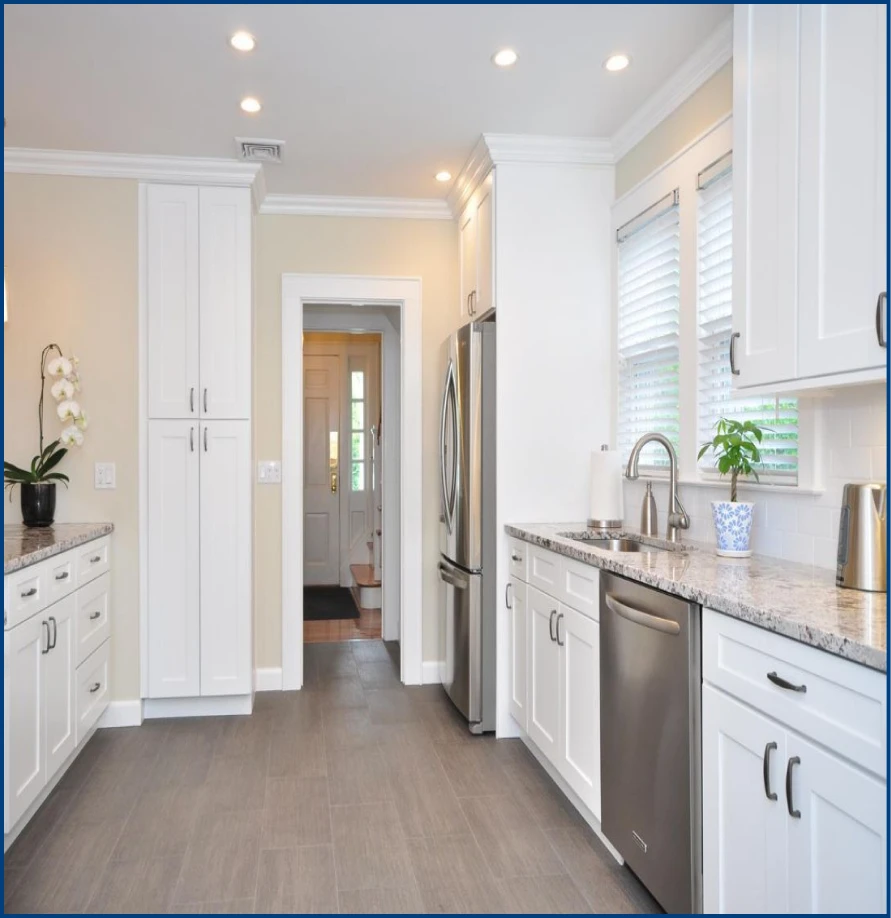
How Kitchen Cabinet Depth Variations Accommodate Appliance and Storage Needs
Cabinet depth is the front-to-back dimension of the cabinet box. By common industry standard, base cabinets are 24 inches deep and wall cabinets 12 inches deep, while tall cabinets come in either depth and cabinets over a refrigerator are often made deeper to reach the front. Choosing a non-standard depth is how a kitchen fits a narrow room, lines up with appliances or gains storage.
Key takeaways
- Base 24 in. deep and wall 12 in. deep are the standard starting points.
- A standard countertop overhangs the base cabinets slightly, so the work surface is a little deeper than the box.
- Appliance depth comes from the spec sheet, not from the cabinet: plan cabinets around the actual model.
- Shallow cabinets save floor space in galleys and over counters; deep cabinets need pull-outs to stay usable.
- Above a refrigerator, a deeper wall cabinet with panels gives a built-in look and reachable storage.
Understanding Kitchen Cabinet Depth
Depth is measured from the front of the face frame to the back of the box, not counting doors and hardware. It decides how far the countertop sticks out into the room, whether appliances sit flush with the cabinets, and how much of each shelf you can actually reach. Deeper is not automatically better: storage at the back of a deep fixed shelf is storage you rarely use.
Standard Cabinet Depths
| Cabinet type | Common depth | Typical use |
|---|---|---|
| Base cabinets | 24 in. | Countertop support, drawers, pots and pans |
| Wall cabinets | 12 in. | Dishes, glassware, everyday items |
| Refrigerator wall cabinet | Often 24 in. | Above the refrigerator, flush with tall panels |
| Tall / pantry cabinets | 12 in. or 24 in. | Pantry storage, brooms, oven cabinets at full depth |
| Countertop | Slightly deeper than the base | Overhang protects the cabinet face and drips |
These are conventions, not codes, and lines vary. Confirm the depths in the catalog for the cabinets you are ordering. For the box construction behind these numbers, see standard cabinet box depth and why it matters.
Depth Variations for Different Appliances
Appliance depths vary widely by brand and model, so the rule is simple: get the spec sheet before you finalize cabinet depths, and plan for door swing, handles and utility connections behind the unit.
Refrigerators
Standard-depth refrigerators stick out past the cabinet face; counter-depth models are designed to sit closer to flush. For a built-in look, frame the refrigerator with tall end panels and a deeper wall cabinet above it. Leave room for the door to swing past the panels and for the water line and ventilation the manufacturer requires.
Ovens and Ranges
Freestanding and slide-in ranges sit between base cabinets and align with the countertop. Wall ovens install in a tall oven cabinet built to the oven maker’s cutout dimensions. Check the required cutout and ventilation before ordering the oven cabinet.
Dishwashers
Most built-in dishwashers are designed to fit under a standard counter between base cabinets of standard depth. Check the opening width, the countertop attachment method and door clearance, and add an end panel if the dishwasher sits at the end of a run.
Microwaves
Over-the-range microwaves hang below a shortened wall cabinet; built-in microwaves go in a base or tall cabinet made for them, or in a trim kit. Use the microwave’s installation guide for clearances and cabinet sizes.
Specialty Appliances
Wine coolers, beverage centers and under-counter refrigerators have their own cutout and ventilation requirements. Plan the cabinet opening from the appliance installation guide and keep the front grille clear.
When to Use Shallower or Deeper Cabinets
| Situation | Depth choice | Why |
|---|---|---|
| Narrow galley or walkway | Shallow base run on one wall | Wider aisle; items do not hide at the back |
| Hallway or dining wall storage | Shallow tall or base cabinets | Storage without blocking traffic |
| Above refrigerator | Deep wall cabinet | Reachable storage; flush built-in look |
| Island seating side | Shallow cabinets back-to-back with bases | Extra storage under the overhang |
| Bulk storage | Full-depth tall pantry with roll-outs | Maximum volume, still accessible |
A common trick for a narrow room is to use wall-depth cabinets on the floor along one side, topped with a narrow counter, while keeping full-depth bases on the work wall. Confirm toe kick and countertop details if you do this, since wall cabinets are not built with a toe kick.
Optimizing Storage with Depth Variations
Deep Drawers Instead of Deep Shelves
In a 24-inch-deep base, full-extension drawers bring the back of the cabinet to you, which is why drawer bases beat door bases for pots and pans. See deep drawer cabinets.
Roll-Outs in Tall and Corner Cabinets
Full-depth pantries and corners hide items at the back. Roll-out trays, pull-outs and lazy Susans make the full depth usable; compare corner options in lazy Susan vs. blind corner.
Adjustable Shelving
Adjustable shelves let you set spacing to what you store, so tall items do not force wasted space above short ones. CCC cabinets use 3/4-inch A-grade plywood adjustable shelves.
Expert Tips for Choosing the Right Depth
- List every appliance with its model number and get the spec sheets.
- Measure the room and the walkways between runs and islands before deciding depths.
- Keep standard depths wherever possible; they cost less and match countertops and appliances.
- Use shallow depths only where floor space is tight or the cabinet holds small items.
- Add pull-outs wherever a cabinet is deep and fixed-shelved.
- See it in person: a showroom visit shows how deep a 24-inch base really feels.
Cabinet Depths at CCC Cabinets
CCC Cabinets stocks 15 door styles in Des Plaines on one construction: 1/2-inch A-grade plywood box with wood veneer, 1/2-inch full plywood back, 3/4-inch adjustable plywood shelves, and 17 mm solid wood dovetail drawer boxes on full-extension soft-close glides. Check available cabinet sizes and depths for your style in the current catalog or with the CCC team when you plan the order. Browse styles like Pure White and Dark Grey on the cabinet styles page, and open a trade account for project pricing. For overall width and depth standards, see cabinet box depth and width standards.
Frequently Asked Questions
What is the standard depth for kitchen cabinets?
The common standard is 24 inches deep for base cabinets and 12 inches deep for wall cabinets, measured without doors. Tall cabinets are usually 12 or 24 inches deep, and wall cabinets above a refrigerator are often made 24 inches deep. The countertop overhangs the base slightly. Confirm exact depths in the catalog for your cabinet line.
Do kitchen cabinets come in different depths?
Yes. Besides the standard base and wall depths, many lines offer deeper wall cabinets for above the refrigerator, tall cabinets in more than one depth, and specialty units. Using wall-depth cabinets on the floor is another way to create a shallow base run in a narrow room.
When should I use shallow base cabinets?
Shallow base cabinets make sense in narrow galleys, hallways, dining room walls and on the seating side of an island, where floor space matters more than storage volume. They also keep small items from disappearing at the back. Keep full-depth bases where you need countertop work space and appliances.
How deep should cabinets above a refrigerator be?
Cabinets above a refrigerator are often made deeper than standard wall cabinets, commonly to match the base depth, so the cabinet front lines up with tall panels beside the refrigerator and its shelf is reachable. Check the refrigerator height and ventilation requirements before sizing the cabinet.
Are deep cabinets better for storage?
Only if you can reach what is inside. Deep cabinets with fixed shelves hide items at the back, so pair them with drawers, roll-out trays or pull-outs. A slightly smaller cabinet that is fully accessible often holds more useful storage than a deep one with a fixed shelf.
How do I fit appliances to cabinet depth?
Start from the appliance spec sheet: depth with and without handles, door swing, required cutout and utility locations. Plan the cabinets and panels around those numbers, leaving clearance for doors to open past panels and for ventilation. Do not order cabinets for an appliance you have not selected yet.
Conclusion
Standard depths work for most of a kitchen; depth variations solve the exceptions: tight aisles, built-in refrigerators, deep pantries and islands. Plan around real appliance specs and accessible storage. To see cabinet sizes and door styles in person, visit CCC Cabinets at 2180 S Wolf Rd, Des Plaines, IL 60018 or call (872) 241-5525.
More in Hardware & Function
Sourcing cabinets for a Chicagoland project?
CCC Cabinets supplies 15 door styles — including Mini White Shaker cabinets — at wholesale prices from our Des Plaines, IL warehouse. Confirm availability for your door style, then choose warehouse pickup near O’Hare or scheduled delivery across Chicagoland.
Door styles to explore: Mini White Shaker · Pure White · Dark Grey
Browse all cabinet styles · Open a dealer account · Call (872) 241-5525 · Talk to our team