How European-Style Cabinet Construction Differs from American Cabinet Building Traditions
The core difference is the frame. European-style cabinets are frameless: the box sides form the front edge, doors mount directly to the box with concealed hinges, and the opening is fully accessible. American cabinets traditionally use a face frame, a solid wood border on the front of the box that stiffens it and supports several door styles. Materials vary in both, so compare the box, drawers and hardware, not the label.
Key takeaways
- Frameless (European) cabinets offer full access to the interior and a flush, modern look.
- Face-frame (American) cabinets add a rigid solid wood front that helps with installation on uneven walls and supports shaker, raised-panel and inset doors.
- Neither style guarantees a material: both are built from plywood, particleboard or MDF depending on the line.
- Full overlay doors on a face frame give a clean, modern look with face-frame strength; that is how CCC builds every style.
1. Overview of cabinet construction styles
European frameless construction grew out of modular, system-based cabinet making, often built around the 32 mm system, a standard grid of holes for hinges, shelves and hardware. American face-frame construction grew out of traditional carpentry, where a solid wood frame gives the box its front edge and its strength. Today both are made in the US and abroad; “European” and “American” describe the method, not the country of origin.
Frameless vs face-frame at a glance
| Feature | Frameless (European) | Face frame (American) |
|---|---|---|
| Front of the box | Edge-banded box sides | Solid wood frame glued and fastened to the box |
| Door overlay | Full overlay with small, even gaps | Partial overlay, full overlay or inset |
| Interior access | Full opening; no frame stiles to reach around | Frame stiles narrow the opening slightly |
| Hinges | Concealed cup hinges on the box side | Concealed hinges are common today; some traditional lines use exposed hinges |
| Installation | Needs flat, square walls and precise leveling | Frame stiles can be scribed to uneven walls |
| Typical look | Modern, slab or slim-profile doors | Shaker, raised panel, inset, or modern with full overlay |
2. Key differences in materials
Material is a line-by-line choice, not a style rule. Many frameless lines use melamine-faced particleboard or MDF boxes because the edge-banded panel is the visible front; higher-end frameless lines use plywood. Face-frame cabinets use a solid wood frame, but their boxes can be plywood or particleboard. Ask for the spec of the box sides, back, shelves and drawer boxes in either case.
All composite wood sold in the US, including plywood, MDF and particleboard, must meet EPA formaldehyde emission rules and be labeled TSCA Title VI compliant, whether the cabinet is frameless or framed, domestic or imported. Our cabinet materials guide explains each part.
3. Design and aesthetic features
European cabinet design favors minimalism: slab or slim-profile doors, tight even gaps, handleless or edge-pull options and long horizontal lines. American cabinetry covers the full range from traditional to modern. Shaker doors, a five-piece door with a recessed center panel, are the most familiar American style, and on a face frame with full overlay doors they read clean and current.
4. Construction techniques
Frameless cabinets rely on the box for strength: thick, square box sides, accurate drilling and solid back panels. Face-frame cabinets add the frame, which keeps the box square during shipping and installation and gives installers material to fasten through and scribe. Both commonly use dowels, cam connectors, screws, rabbets or dados to join the box; quality shows in tight joints, square boxes and secure backs.
What full overlay means on each type
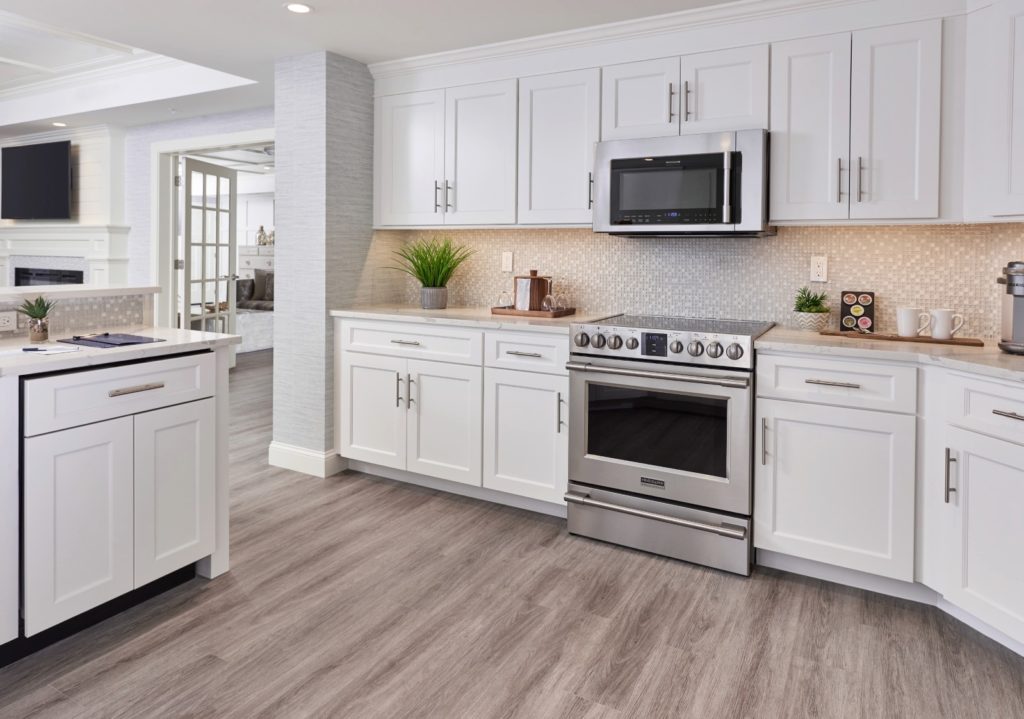
On frameless cabinets, full overlay is standard: doors cover the box edges. On face-frame cabinets, full overlay doors cover most of the frame, leaving a small reveal, so the kitchen looks nearly as continuous as a frameless one while keeping the frame’s rigidity.
5. Functionality and customization
Frameless boxes give slightly wider openings and drawers for the same cabinet width, which helps with large pots and pull-outs. Face-frame cabinets offer more door-style flexibility, including inset doors, and are often easier to fit into older homes with uneven walls. Soft-close hinges, full-extension glides and pull-outs are available on both; check the hardware spec rather than assuming.
Choosing between frameless and face-frame cabinets
| Your situation | Better fit | Why |
|---|---|---|
| Modern slab-door kitchen, new construction | Frameless | Flush look, maximum access, square new walls |
| Shaker or raised-panel kitchen | Face frame | Traditional door styles and proportions |
| Older home with uneven walls | Face frame | Frame stiles can be scribed for a tight fit |
| Maximum drawer width in a small kitchen | Frameless | No frame stiles narrowing the opening |
| Modern look with framed strength | Face frame with full overlay doors | Clean reveals, rigid front |
6. Environmental considerations
Environmental performance depends on the specific product, not the construction style. Look for TSCA Title VI labels on composite wood and, if responsible sourcing matters to you, a product-level certification such as FSC that you can verify. California’s CARB Phase 2 rule preceded the national TSCA Title VI standard for composite wood emissions.
7. Cost comparison
Cost depends on materials, finish and tier more than on frameless versus framed. Budget frameless lines can be inexpensive because of melamine particleboard boxes, while high-end European systems can be among the most expensive cabinets available. Face-frame cabinets span a similar range. Compare quotes for the same layout and the same box, drawer and hardware spec; see premium vs budget kitchen cabinets.
Closets and other cabinetry
The same principles apply beyond the kitchen. Many closet systems are frameless, melamine-faced panels on a drilled hole grid, which makes shelves and fittings easy to adjust. Built-in closets and bathroom vanities with face frames read more like furniture and can be scribed into older rooms.
How CCC Cabinets is built
CCC Cabinets uses face-frame construction with full overlay doors on all 15 in-stock styles: 3/4-inch birch face frames, 1/2-inch A-grade plywood box sides with wood veneer, a 1/2-inch plywood back, 3/4-inch plywood shelves, MDF door center panels, 17 mm solid wood dovetail drawers on full-extension soft-close glides, and 1-1/4-inch concealed 6-way adjustable soft-close hinges. The result is a clean full-overlay look on a rigid framed box. Browse the in-stock cabinets, or open a trade account with your cabinet supplier in Des Plaines.
Frequently Asked Questions
What are the main differences between European and American cabinets?
European cabinets are frameless, with doors mounted directly to the box sides and full access to the interior. American cabinets traditionally have a solid wood face frame on the front of the box, which adds rigidity and supports more door styles. Materials, quality and price vary within both types.
Are frameless cabinets better than face-frame cabinets?
Neither is better in every case. Frameless cabinets offer full interior access and a flush modern look; face-frame cabinets offer a rigid front, easier fitting to uneven walls and more door options. Choose based on style, the condition of the walls and the box and hardware quality of the specific line.
Do European frameless cabinets have more storage space?
Slightly more usable opening, because there are no frame stiles narrowing the front. That helps with wide drawers and pull-outs. In practice, the drawer and accessory layout usually affects usable storage more than the construction type.
Are European cabinets cheaper than American cabinets?
Not as a rule. Budget frameless lines with particleboard boxes can be inexpensive, but premium European systems are among the most expensive cabinets. Compare the same layout with the same box, drawer and hardware spec to see real price differences.
Can face-frame cabinets look modern?
Yes. Full overlay doors cover most of the face frame and leave small, even reveals, so a face-frame kitchen with slab or slim shaker doors and simple hardware can look nearly as continuous as a frameless one while keeping the frame’s strength.
What is the 32 mm system?
It is the standard hole grid used in European frameless cabinet making. Holes drilled at 32 mm spacing on the box sides locate hinges, shelf pins and hardware, which makes production efficient and lets parts and fittings line up consistently.
Are CCC Cabinets frameless or face frame?
CCC Cabinets are face-frame cabinets with full overlay doors. Every style uses a 3/4-inch birch face frame on a plywood box, with concealed 6-way adjustable soft-close hinges, so they combine a clean modern reveal with the rigidity of a framed cabinet.
8. Conclusion
European frameless and American face-frame cabinets differ in how the box is built and how doors attach, not automatically in quality. Choose the construction that fits your style, walls and storage needs, then judge the specific line by its box, drawers, hardware and finish. For framed full-overlay cabinets in stock, visit the CCC Cabinets showroom at 2180 S Wolf Rd, Des Plaines, call (872) 241-5525, or use our ordering support page.
More in Cabinetry
Sourcing cabinets for a Chicagoland project?
CCC Cabinets supplies 15 door styles — including Mini White Shaker cabinets — at wholesale prices from our Des Plaines, IL warehouse. Confirm availability for your door style, then choose warehouse pickup near O’Hare or scheduled delivery across Chicagoland.
Door styles to explore: Mini White Shaker · Millennium Grey · Millennium Blue
Browse all cabinet styles · Open a dealer account · Call (872) 241-5525 · Talk to our team